How Funeral Homes Help Families With Immediate Arrangements After a Death

North Dallas Funeral Home & Cremation Services • November 2, 2026

Share this article

Key Takeaways


  • Calling a funeral home early does not mean every service detail must be decided immediately. 
  • Initial guidance helps families separate urgent care needs from choices that can be discussed later. 
  • A funeral home may coordinate communication, transportation, and paperwork guidance beyond the ceremony itself. 
  • Clear roles, simple priorities, and honest conversations can make family decisions more manageable. 
  • Families can continue asking questions and adjusting personal details as arrangements take shape. 


You Do Not Need Every Answer First 


After a death, shock can make even simple questions feel hard to answer. Reaching out to a Carlton funeral home can be an appropriate first step when your family is still unsure about burial, cremation, a service date, or who needs to be involved. 


The first conversation is not a test of whether you are ready. It gives the funeral home enough information to understand where your loved one is, whether immediate care coordination is needed, and who should receive updates. Details such as obituary wording, music, readings, flowers, and the size of a gathering can usually be addressed after the immediate situation is understood. 


North Dallas Funeral Home & Cremation Services has phones answered by a licensed funeral director at all hours. A family can begin with the facts they know and say plainly what they do not yet know. That can reduce the pressure to make emotional decisions before everyone has had a chance to speak. 


Myth: Every Decision Is Urgent 


Some decisions do need early attention, but families do not need to settle every part of a farewell in the first call. The difference is easier to see when choices are grouped by timing.

Timing Information To Share What Can Often Wait
First contact Place of death and caller details Ceremony style
Early planning Family decision-maker and preferences Music and readings
Before service details Desired gathering or disposition direction Personal tribute items
As plans develop Faith, cultural, or family needs Obituary wording and photos

The most time-sensitive task is making sure your loved one is cared for appropriately and that the right family member can receive guidance. From there, a funeral director can explain the next priorities in a calm order. 


Waiting briefly to discuss personal touches is not neglecting your loved one. It gives relatives time to locate wishes, speak with important family members, and choose details that feel true to the person being honored. For additional perspective on arranging a service within a limited timeline, review planning services on short notice. 


What Should Families Share During First Contact? 


Families should share the basic facts they know, including the loved one’s name, where the death occurred, a return phone number, and who will help make arrangements. That information helps a funeral home understand the immediate situation and guide the family without requiring a complete plan. 


It also helps to mention whether the person left written wishes, whether relatives are traveling, and whether there are important religious, cultural, or military traditions to consider. If the death occurred in a hospital, care community, or at home, say so. The funeral home can then explain what information is useful next and who may need to communicate. 


Do not delay a call because you cannot find every document or reach every relative. Unknown details can be clarified later. It is better to explain that the family is gathering information than to feel forced into guesses that may not reflect your loved one’s wishes. 


Myth: A Funeral Home Only Plans Ceremonies 


A funeral home’s role often begins before anyone discusses a chapel, church, graveside gathering, or memorial service. After a death, families may be managing calls from relatives, questions from care providers, travel plans, and their own grief at the same time. Guidance can bring those moving parts into a workable order. 


Funeral homes can help families understand the immediate sequence of events, coordinate transportation, and discuss care of the person who died. They can also provide direction on the information and documents that may be needed as arrangements continue. This is especially helpful when one relative is handling calls while another is trying to notify family members or locate written wishes. 


At North Dallas Funeral Home & Cremation Services, the dedicated care team takes a loved one into its care, and the funeral home owns and operates its crematory rather than using a third-party removal service or crematory. Knowing who is responsible for care from the place of death through final disposition can be an important point of clarity for a grieving family.


Guidance Through Immediate Priorities 


Immediate priorities usually involve care, communication, and determining who has authority within the family to make choices. A funeral director can help put those matters in order before asking about more personal parts of the service. 


That order matters. A family that starts with a simple plan for notifications and key decisions often has more room later to choose readings, photographs, speakers, and other meaningful details without feeling rushed. 


Coordination with Family and Providers 


Funeral home coordination can reduce the number of separate conversations a family must manage. Staff may communicate with the place of death, help organize transportation, and keep the primary family contact informed about what is happening next. 


Families should identify one or two people who can receive updates and share them with others. This does not exclude anyone from the process. It simply prevents conflicting instructions and reduces the chance that essential information gets lost in a fast-moving day. A broader guide to funeral home support can also help relatives understand the roles involved. 


Questions About Documents and Next Steps 


A funeral home can explain which personal information and documents may be useful, but families do not need to have everything ready at once. Start with what is accessible, then ask which items should be located next. 


If records are missing or the family is uncertain about a prior plan, say so early. Clear communication allows the arrangement discussion to proceed at a reasonable pace instead of relying on assumptions. 


How Can Families Make Choices More Manageable?


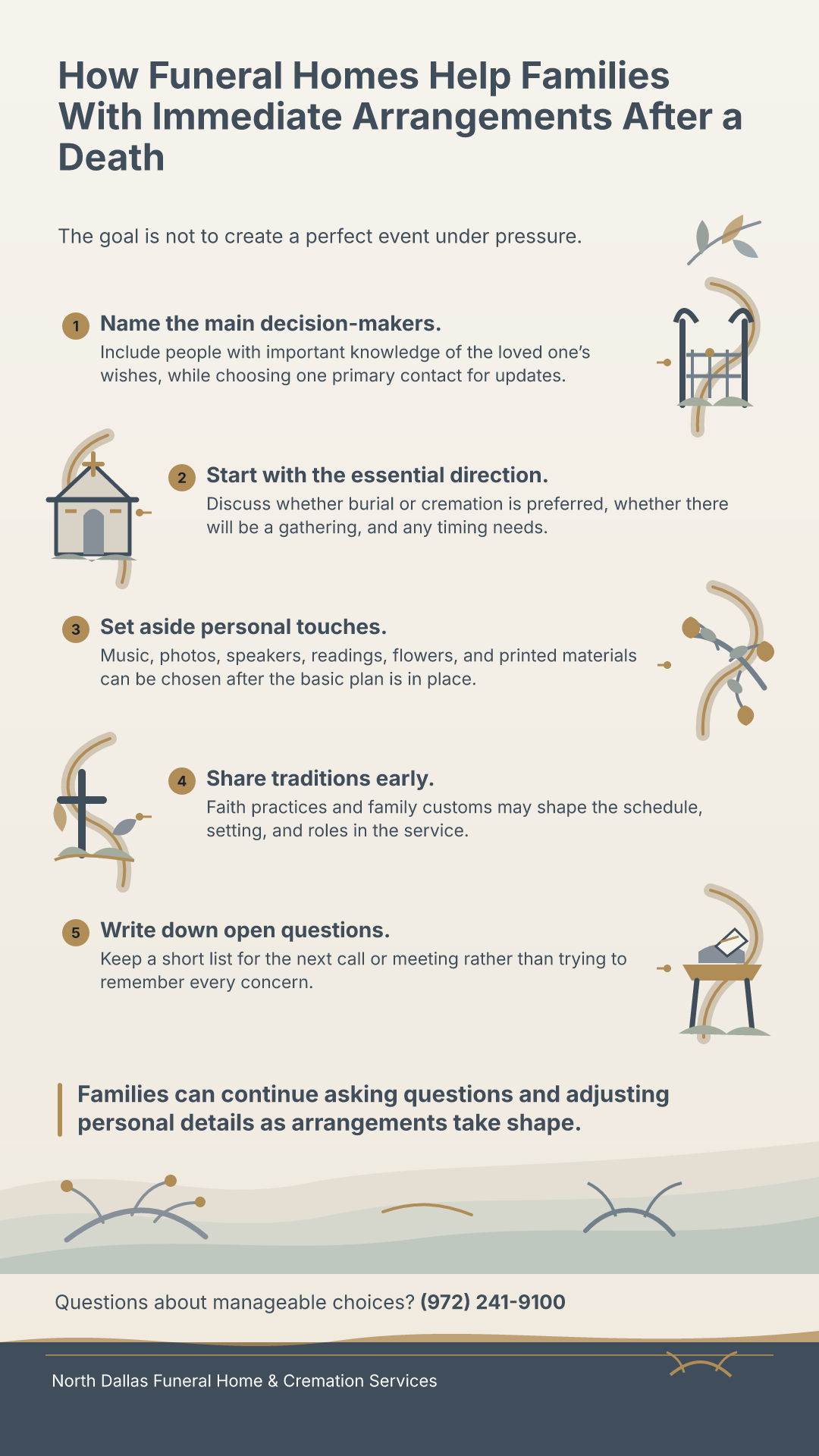
Families can make arrangements more manageable by deciding who will participate, separating essential choices from personal details, and handling one category at a time. The goal is not to create a perfect event under pressure. It is to make thoughtful decisions that fit the person and the family. 


Use this sequence to keep the discussion grounded: 


  1. Name the main decision-makers. Include people with important knowledge of the loved one’s wishes, while choosing one primary contact for updates. 
  2. Start with the essential direction. Discuss whether burial or cremation is preferred, whether there will be a gathering, and any timing needs for close relatives. 
  3. Set aside personal touches. Music, photos, speakers, readings, flowers, and printed materials can be chosen after the basic plan is in place. 
  4. Share traditions early. Faith practices and family customs may shape the schedule, setting, and roles in the service. Families considering Hispanic Catholic funeral traditions should mention those preferences at the beginning of planning. 
  5. Write down open questions. Keep a short list for the next call or meeting rather than trying to remember every concern in the moment. 


This approach also helps when relatives disagree. Instead of debating every detail at once, the family can return to the loved one’s known wishes and handle decisions in a practical order.


Infographic: How Funeral Homes Help Families With Immediate Arrangements After a Death

Myth: Support Ends After Arrangements Begin 


Arrangements are not fixed the moment the first conversation ends. Families can continue asking questions as details take shape, and they should speak up if a plan no longer feels right or new information becomes available. 


Tell the funeral home about cultural customs, faith traditions, accessibility concerns, travel changes, or family members who need a clearer explanation of the plan. A meaningful farewell often comes from these conversations, not from choosing every detail quickly. 


The same is true when emotions shift. A relative may remember an important preference, find a note from the person who died, or realize that a small gathering feels more fitting than a larger one. Sharing that information early gives the planning process room to adjust respectfully. 


A Carlton funeral home can provide steady guidance when the family’s first need is simply to understand what happens next. North Dallas Funeral Home & Cremation Services is available to talk through immediate arrangements with care. Call (972) 241-9100 to discuss the next steps.


Recent Posts

Unmarked sympathy card in a linen basket beside rosemary on a quiet visitation foyer table
By North Dallas Funeral Home & Cremation Services • October 26, 2026
Learn respectful visitation etiquette, what to say, wear, and bring when supporting a grieving family. Call (469) 818-0456 for caring guidance today.
Smartphone beside a closed planning folder on a quiet North Texas patio for sharing funeral wishes
By North Dallas Funeral Home & Cremation Services • October 19, 2026
Learn how to preplan a funeral when relatives live far away, organize decisions, and keep everyone informed. Call (469) 818-0456 today for guidance.
Quiet flexible chapel foyer with movable chairs, blank cards, and an olive branch
By North Dallas Funeral Home & Cremation Services • October 12, 2026
Compare chapel services and church funerals with care. Find the setting that fits your family and loved one. Call (469) 818-0456 today for guidance.
 Two quiet waiting chairs and an unmarked travel envelope in a softly lit funeral home corridor
By North Dallas Funeral Home & Cremation Services • October 5, 2026
Learn how an Addison funeral home helps families set viewing and visitation times around travel, services, and needed flexibility. Call (469) 818-0456 today.
Open blank tradition notebook and closed brass music box on a sunlit oak window seat
By North Dallas Funeral Home & Cremation Services • September 28, 2026
Plan meaningful funeral traditions before a loss with clear guidance for families in Farmers Branch. Call (972) 241-9100 today for caring support now.
Blank planning papers and a document envelope stored with a key in an easy-to-find oak drawer
By North Dallas Funeral Home & Cremation Services • September 21, 2026
Document funeral wishes so loved ones have clear direction during a hard time. Get organized guidance from a Carlton funeral home. Call (972) 241-9100 today.
Quiet consultation room with a clock, blank folder, note cards, and telephone prepared
By North Dallas Funeral Home & Cremation Services • September 14, 2026
Need to plan a service quickly? An Addison funeral home can help organize priorities, details, and family communication. Call (972) 241-9100 today.
Open fireproof document box with unmarked insurance, military, and cemetery record folders
By North Dallas Funeral Home & Cremation Services • September 7, 2026
Learn what to bring when meeting a Farmers Branch funeral home after a death, from IDs to wishes and key questions. Call (972) 241-9100 today.
graveside-funeral-planning-cemetery-support-guide
By North Dallas Funeral Home & Cremation Services • August 24, 2026
Carlton funeral home guidance for graveside services, cemetery coordination, cremation, burial, and family support with calm planning help.
Addison funeral home burial planning scene with graveside chairs under a shade tent after light
By North Dallas Funeral Home & Cremation Services • August 17, 2026
Addison funeral home guidance for burial services, traditions, visitation choices, cemetery planning, and caring support for grieving families.
Show More